
Johnston City Directory Holdings
Johnston does not have a verified, continuous city-only directory series. The strongest shelf is the Des Moines Public Library collection of Des Moines and Polk County volumes. A local person may be filed under Johnston Station, a township, a rural route, or a county listing, so the place label must be read in the context of the year. The historic city directories catalog identifies the available years and formats.
| Directory collection | Years | Where kept | Access route |
|---|---|---|---|
| Des Moines and Polk County scans | 1866-1922, with gaps | Des Moines Public Library | Free online scans |
| Historic directory microfilm | 1866-1935 | Central Library | In-person research |
| Printed city directories | 1910-present | Central Library | In-person shelf access |
| Telephone books | 1957-present | Central Library | In-person reference |
| Johnston school yearbooks | 1928 onward | Johnston Public Library | Digital research resources |
The online city directory run is not annual. Missing years include 1918, 1896-1897, 1885, and 1887, while the 1870s and 1880s are sparse. Absence from one book is not proof that a person had left Polk County. Check the closest years, print or microfilm holdings, newspapers, and census schedules before drawing that conclusion.
Each format has a practical strength. Online scans allow quick name tests and page downloads. Microfilm can preserve pages that optical character recognition does not read well. Printed books make it easier to move between the alphabetical list, street guide, institutions, railroads, churches, schools, and county officers in the same edition. Ask reference staff about all three when a scan search returns nothing.
Johnston Directory Years by Publisher
Publisher and year matter because headings, abbreviations, and geographic reach changed. R.L. Polk issued the listed 1892-1922 volumes. J.P. Bushnell appears in the 1871-1889 run, and Mills & Co. produced the earliest listed snapshots in 1866 and 1869. Record the title page as well as the directory entry. That simple step keeps a citation tied to the correct edition.
| 1920s | R.L. Polk, 1920, 1921, and 1922 |
|---|---|
| 1910s | R.L. Polk, 1910-1917 and 1919 |
| 1900s | R.L. Polk, 1900-1909 |
| 1890s | R.L. Polk, 1892-1895, 1898, and 1899 |
| 1880s | J.P. Bushnell, 1881-1884, 1886, 1888, and 1889 |
| Earlier | J.P. Bushnell selected 1870s years; Mills & Co. in 1866 and 1869 |
The digitized 1922 Polk County directory shows how a scan can be searched before the original page is checked.
OCR can miss faint type and short abbreviations. Browse the page image around a hit, then save the volume year and printed page number.
Read Johnston City Directory Entries
A 1922 entry reads, in compressed form, “John F Johnston, agt Interurban Rt Co, res 508 Manzana av.” It connects a name with an Interurban role and a residence at publication time. It does not prove ownership, continuous occupancy, or a match to a modern parcel. The city history makes the lead notable because John F. Johnston is tied to the name Johnston Station.
| Name | John F Johnston |
|---|---|
| Role | “agt,” meaning agent |
| Organization | Interurban Rt Co |
| Residence | “res 508 Manzana av” |
| Not supplied | No spouse, ownership, or parcel field appears in this entry |
Directory marks are publisher-specific. Photograph or save the key before interpreting them.
- Street guide
- The section arranging streets and avenues rather than people, useful for checking an address after a name hit.
- Householder index
- A list centered on the person identified as head of a household; it may omit other people at the address.
- Abbreviation key
- The volume's own list explaining short forms such as occupations, organizations, and residence marks.
- Criss-cross directory
- A later address-first directory. No official Johnston-specific reverse series was found, so do not apply this label to the verified street guide.
Search Johnston Station Records
“Johnston Station” is an essential search term, not a separate modern city. Johnston's history places the Interurban line through the area beginning in 1907. Search that phrase, “Interurban,” a surname, and an address in the 1907-1922 city directories and newspapers. Older sources may also use Beaver Creek Settlement, Ridgedale, or Huntsville.
Place names changed before Johnston incorporated in 1969. Camp Dodge and farm research sites can also appear as institutional or rural landmarks rather than standard city addresses. Keep the wording from each record. Converting it too soon to a current city line can hide the very evidence needed to reconcile the location.
Search tip. Run the same surname with Johnston, Johnston Station, and the relevant township, then note which label the source actually prints.
Johnston Library Bridges the Gaps
The Johnston Public Library research desk connects directory names to local yearbooks, Johnston newspapers, the Iowa Digital Library, Iowa Digital Newspapers, heritage collections, The Goldfinch, and The Palimpsest. Johnston High School yearbooks extend back to 1928. Ancestry Library Edition requires an in-library visit, and some databases require a card number beginning BJOH.
The Des Moines Public Library historic city directory page shows the collection years and formats used for Johnston city directory research.
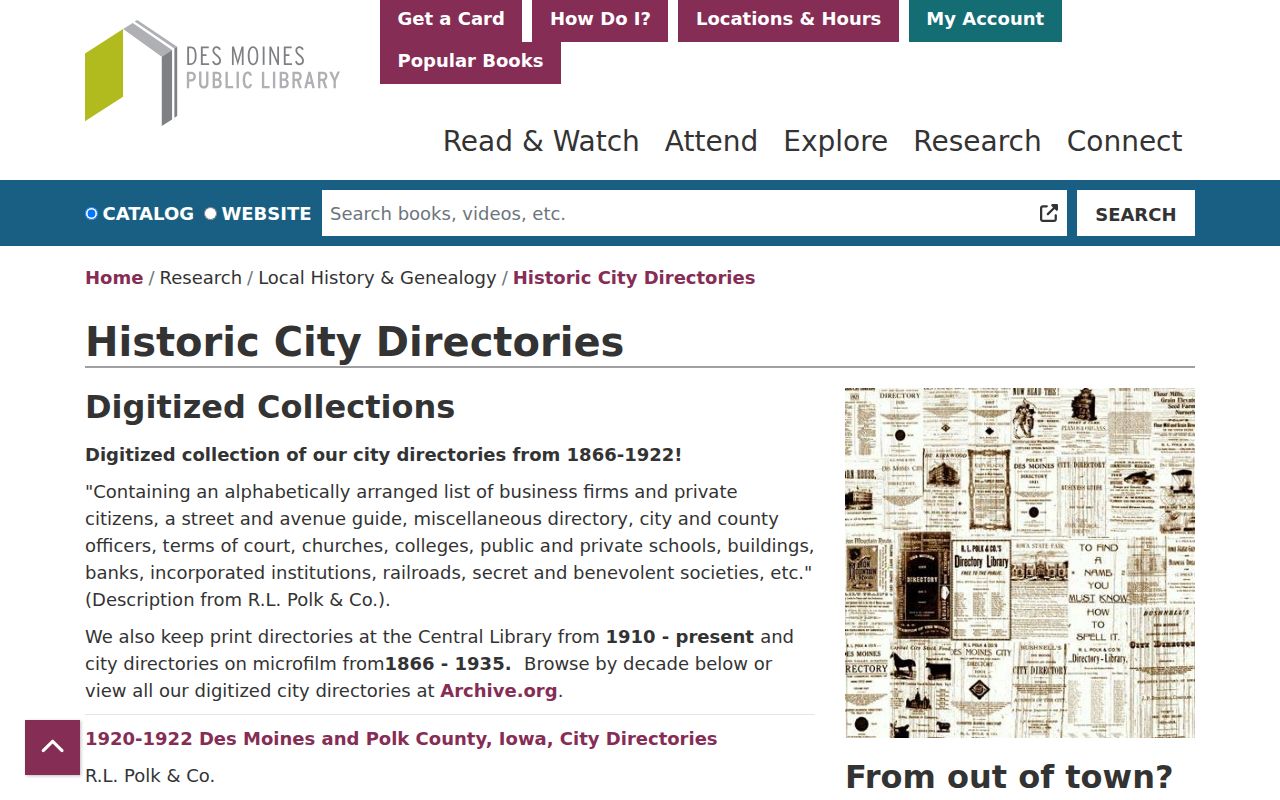
The historic directory screen establishes coverage before time is spent on a missing year. For local help, Johnston Public Library is at 6700 Merle Hay Road and lists 515-278-5233.
Johnston and Des Moines libraries serve different roles. Johnston holds the local bridge through school and community material. DPL supplies the deep Polk County city directory shelf, microfilm, telephone books, and reference service. Interlibrary loan can help when a title is not immediately available.
Confirm Johnston Directory Names
A city directory entry is a dated lead. DPL's newspaper and magazine index adds events and notices that can distinguish people with the same name. The Des Moines Register keyword index covers 1986-2020 and its obituary index covers 1960-2020. Digital full text reaches back to 1871 with some local exclusions. The Tribune and Iowa Bystander have separate listed runs.
The library newspaper index should be searched by name, address, organization, and date range.

The screen is an index gateway, not the full article. Save the publication, date, page when supplied, search term, and archive URL. If a copy is not online, DPL accepts paid research requests by email or mail. Its form lists a $20 hourly rate, a $10 minimum, prepayment, and a ten-business-day target. Reference staff are reached at 515-283-4152 extension 3.
The Iowa Genealogical Society offers another request channel for Iowa county research. Its published service does not research living people or adoption matters. Rates are listed by member status, and payment is due before work begins. A narrow request works best: give the full name, variants, likely Johnston place label, year range, and the specific directory or newspaper fact sought.
Trace Families in Johnston Directories
Follow a household one edition at a time. Pair city directory years with public federal census years, which currently reach 1950 for named-person research. The census can add household ties and a place or township label, while the directory can narrow a move between census decades.
- Start with the closest known directory year and search every name spelling.
- Read the printed entry and the abbreviation key, then save the exact address and role.
- Check the street guide for that address and record nearby names only as leads.
- Move backward and forward through available editions, marking each gap rather than filling it by assumption.
- Compare the matching census, newspaper index, obituary, deed, or probate file.
A disappearance may mean a move, death, omission, changed spelling, or an unlisted year. If the goal becomes a current address trail, use the Johnston street directory workflow rather than stretching a historical volume beyond its date.
Older Johnston Records Beyond Directories
The State Historical Society of Iowa supplies the county-record backbone when city directories stop. Polk holdings include deed indexes from 1848-1901, a town-lot index from 1851-1901, original land entries from 1846-1855, the Farm Names Register from 1911-1978, probate files, plats, naturalizations, and vital volumes. These are archive or microfilm routes, not a single resident search.
The Johnston Station Historical Society adds artifacts and the Simpson House and Barn story. The house was completed in 1902, the clay-tile barn was rebuilt in 1936, and both moved to Johnston Commons in 2001. Those dates can guide directory, newspaper, deed, and map searches, but the society does not claim a full list of occupants.
County archives also help interpret what city directories leave out. Auditor plats identify land layout, Recorder books follow conveyances, and probate or naturalization files may distinguish two people with similar names. The Farm Names Register can bridge an old rural description to a family name before a standard Johnston street address existed. Always carry the directory year into the archive search.
For a remote alternative, DPL offers its paid request form and the Iowa Genealogical Society accepts county-focused research requests. In person, bring name variants, the likely years, and historic place terms. There is no verified Johnston-only reverse directory, complete cemetery search, or full resident index, so a careful city directory search ends with a documented source chain, not a single all-purpose result.